

By Dan Beaver
All forms of motorsports are inherently dangerous. That risk occasions sporadic tragedies and highlights triumphs as adrenaline fuels athletes and spectators alike. But when adrenaline fades, it is the responsibility of somber men and women to mitigate those risks.
In dirt bike racing, the task of keeping riders safe is shared by every stakeholder: the rider, their coach and parents, track officials, sanctioning personnel, and at the top of that pyramid, the American Motorcyclist Association (AMA).
“We know that motorcycle racing is dangerous, but if you’re going to race in an AMA-sanctioned race, they are better prepared than anyone else in the event that chaos happens,” Tim Cotter, Vice President of Operations for MX Sports, Inc.
Racers seek satisfaction from tiptoeing on a knife blade, looking for the elusive boundary that tells them they have found the greatest degree of speed. Longtime observers can sense when a rider is on the edge, and they achieve a vicarious thrill from watching their favorite riders avert disaster.
But the only way to find the edge is to step over it occasionally. In the history of motorsports, there has never been a successful racer who has not stepped over the line and paid the price. It’s not a matter of whether a racer will crash; it’s when and how severely.
As countless riders have raced and crashed, the AMA has evolved its rules to meet contemporary challenges.
“Safety measures have evolved over the last 50 years through the AMA and AMA Congress,” Cotter said. “The AMA Congress is the rulemaking body of the AMA, and over the years, they’ve developed rules for safety – the foundation of the rules was because of safety.”
Over that half-century, countless riders have hit the ground. Many suffered minor injuries, others have been severely injured, and some have died as a result of accidents, but all those incidents provide a knowledge base that makes the sport safer.
“We have what are called competition commissions, which evolved from AMA Congress, and the motocross commission has about 30 members on it,” said Mike Burkeen, AMA’s Deputy Director of Amateur Racing. “They are Hall of Famers, AMA ex-pros like former motocross racer Chad Reed, promoters, referees, really a huge cross-section of the industry are part of that motocross commission.”
Motorcycle racing is unique in motorsports. Some forms of safety equipment are unavailable compared to auto racing. Riders compete without fenders and roll bars, which provide an added measure of safety for four-wheeled racers. As a result, when accidents occur, riders are exposed to the elements.
“When the gate drops on a Saturday morning and on a two-day event, it’s probable that someone’s going to get hurt,” Cotter said. “And so, we’ve got to be proactive and try to mitigate those occurrences. You’re never going to do away with them completely as it’s the nature of what racing is.”
The AMA reviews incident reports sent to its offices at the beginning of each week, detailing any serious accidents on member tracks. These are compiled and studied, and often provide the basis for new rules.
“Every year, two to three times a year, we meet … and those guys will bring together proposals, and it’s really based on what we see in the field as the year goes by,” Burkeen said.
One addition to the AMA rulebook is a modification to the chest protection rule. For many years, this safety equipment has been mandated for youth riders, but in 2026, the rule will impact both youth and amateur racers.
“The commission put [the rule mandating chest protection] together as a proposal, it got posted online for 10 days for public comment, and then after that it went to a vote by the commission,” Burkeen said.
It passed almost unanimously.
“What happens is every time there’s a tragedy, the media and the internet goes crazy. What they don’t understand is I think about this stuff every day,” Burkeen said. “I don’t wait for an accident. Our commission doesn’t wait for an accident. We try to be proactive and we try to think about what’s going on. If we waited until someone got hurt and then made a decision on [a] change, that wouldn’t be smart.”
The Gold Standard
That attention to safety, in both reactive and proactive ways, is what has made the AMA the gold standard for motorcycle racing.
To become an AMA-sanctioned track or event, promoters must adhere to the association’s guidelines, rigorously compiled with decades of experience.
“The first thing is they need to run under our rule book,” Burkeen explained. “That means no minibikes out there with big bikes, no five-year-olds out there with 15-year-olds, things like that.”
“And they must follow our rules as far as yellow flags go and all the safety protocols.”
To ensure adherence to flag rules, penalties have been made harsher for riders who ignore yellow or red cross flags. They will incur greater position reductions from two positions to five for failing to acknowledge yellow flags and 10 for ignoring red cross flags.
“At two [positions] kids are like, I’m going to give [it] a shot; I’ll probably get away with it — if I don’t, it’s only two spots,” Burkeen said. “They’re going to think twice on five spots, and it’s going to be 10 spots for red cross flags.”
Red cross flags indicate that a rider is slow to rise after an incident. Often this is attributable to an injury.
“[AMA tracks and events] also have to follow our EMS guidelines,” Burkeen added, “which means they have to have BLS (Basic Life Support) at all the races, with an ambulance on site at all the races.”
“The exception to that is if they have an alternative, for example, if they have a fire station that’s two blocks down the street, and they can get an ambulance there before they can even get the kid on a stretcher, then they’ll file what’s called an alternative ambulance plan, and then we will approve or disapprove that.”
Mitigating risk is mission-critical for the AMA.
“All of our promoters have access and are mandated to risk management training,” Burkeen said. “It’s a training module that we have online. They go through the training, and they have to be approved and pass the risk management module training. They have to have a certified risk management officer at every race. That’s the first thing.”
There are also technical rules that require education.
“The second thing is we have flagger training available on the website for them to look at, and then I’m personally available pretty much 24-7 to every promoter in the country,” Burkeen continued. “Anytime they need anything, and they know they can call me anytime, and I will help them through any of the issues that they have there.”
“We have insurance workshops. We have an organizer newsletter that goes out to every organizer at least quarterly, and lately more often.”
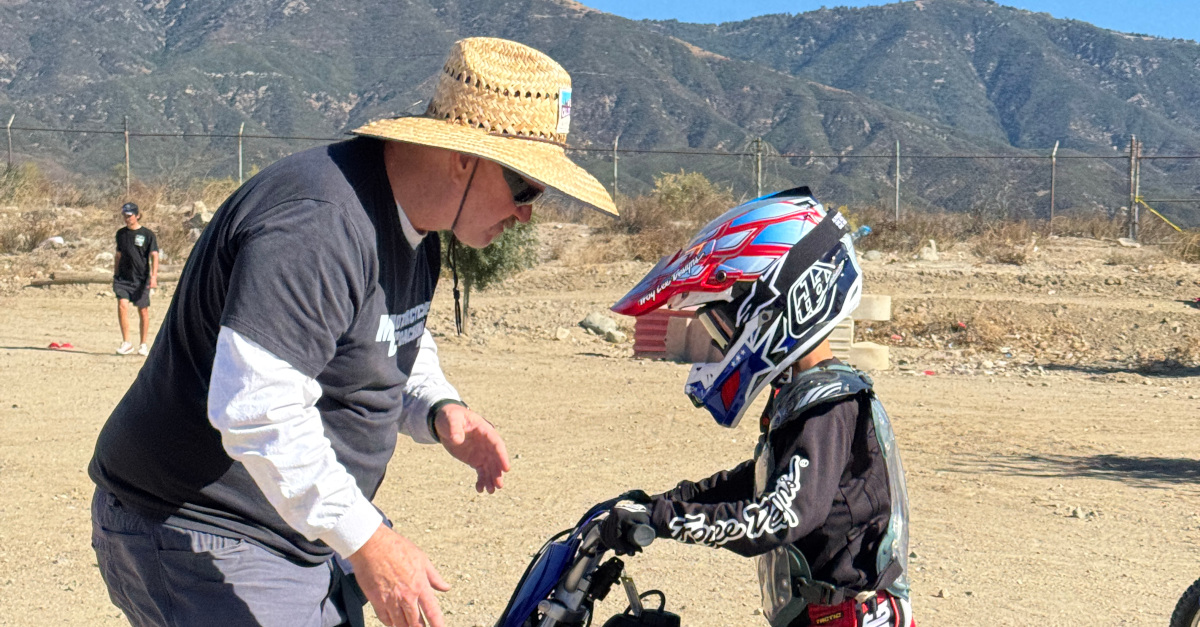
Adequate and responsible coaching is an essential component of keeping riders safe. While that is outside the AMA’s purview, the AMA has partnered with the United States Motorcycle Coaching Association (USMCA) to ensure proper coaching and safety are available. Read more about the USMCA here.
“Our gold standard is the USMCA,” said Burkeen. “That’s what the USMCA was created for with the certified coaches, and any AMA event that we sanction that has coaching involved, the coaches have to be USMCA certified.”
Different Ways to Participate
Safety is everyone’s responsibility.
As with any sport, the development of talent is vital to the growth and health of dirt bike racing. For every Jett Lawrence who grabs headlines for his ability to win races and championships, there are thousands of hopeful young riders eager to take his place.
Small facilities and practice tracks can be found in every state of the union, and these riders put in hours and hours of training. They press the limits, test the boundary of grip, and occasionally crash.
But not every facility adheres to the AMA’s rigorous guidelines. It’s essential to know the difference between AMA sanctioned and non-AMA sanctioned facilities.
“There are different ways to participate in the sport, and some are much safer than others,” Burkeen said. “And honestly, if you look at our track record versus the unsanctioned track record, we are night and day better in every way in injuries and fatalities and fairness. There’s no competition whatsoever. We are the gold standard in putting on the safest possible events.”
And while risk management is essential, it is equally important to recognize independent responsibility. The AMA provides the groundwork and foundation, but those rules are ineffective if the men and women on site do not implement them.
“The other thing that’s very clear in our rule book is that the onus on running the races is on the promoter; the AMA does not manage or run races,” Burkeen said.
Dirt bike racing is the ultimate contact sport. Instead of facing off against other athletes, riders challenge the unforgiving ground and hardened metal of their own and competitors’ bikes. Injury will always be a part of this sport, but it’s comforting to know that somber men and women are dedicating their lives to make it increasingly safer.